

Affiliate Disclosure
Some links on this page are affiliate links. As an Amazon Associate, we earn from qualifying purchases — at no extra cost to you. We do not buy, install, or physically handle the lights and decorations we cover; our rankings come from aggregated owner feedback and expert consensus, not first-hand testing. Commissions never change our verdicts. How we research · full disclosure.
Top 3 Picks
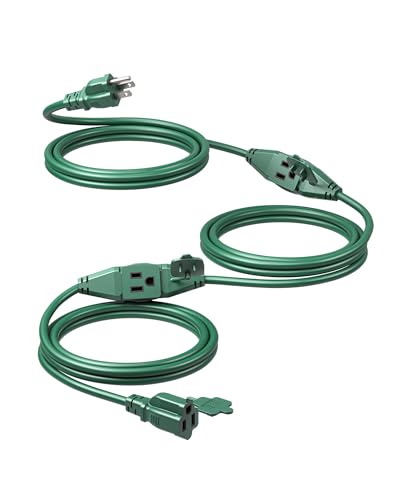
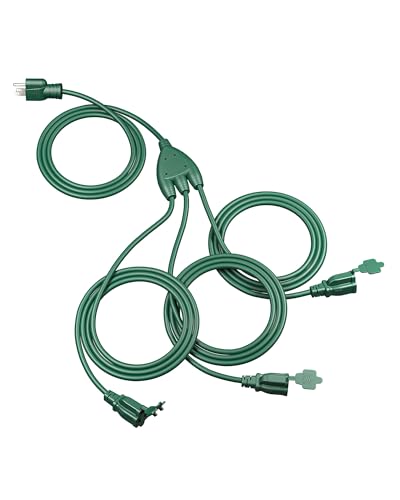
For most outdoor Christmas light displays, use a 16-gauge outdoor-rated cord for short LED runs, a 14-gauge cord as the safe all-round choice, and a 12-gauge cord for runs over 100 feet or heavier loads. Whatever the gauge, the cord must be marked for outdoor use (SJTW) with a grounded three-prong plug, and every run should feed from a GFCI outlet.
How extension cord gauge (AWG) works
Cord thickness is measured in AWG (American Wire Gauge), and it runs backwards: a lower number is a thicker wire. A thicker wire carries more current safely and loses less voltage over distance. That matters because a cord that's too thin for the load and length suffers voltage drop — the lights at the far end dim, and the cord itself heats up. Choosing the right gauge is about matching the wire to two things: how many watts your lights draw, and how far the cord has to run.
Matching gauge to amps and wattage over distance
Start with the load. Add up the wattage printed on your light sets, and divide by 120 to get the amps the run will draw. Because LED sets draw so little wattage, a modest LED display on a short run is perfectly happy on a light cord. As you add strands or extend the distance, the amps and voltage drop both climb, so you step down a gauge number to compensate. To size the load itself, see how many amps do Christmas lights use and how many Christmas lights can I string together.
| Gauge (AWG) | Cord thickness | Good for | Practical length |
|---|---|---|---|
| 16-gauge | Light-duty | Small LED displays, single strands | Up to ~50 ft on a light load |
| 14-gauge | Medium-duty | Most whole-house LED displays | Up to ~100 ft |
| 12-gauge | Heavy-duty | Long runs, incandescent or mixed loads | 100 ft and beyond |
16-gauge, 14-gauge or 12-gauge? Voltage drop and load
Here's the quick rule. A 16-gauge cord covers small LED displays on short runs. A 14-gauge cord is the sensible default for most whole-house displays and the gauge to reach for when you're unsure. A 12-gauge cord is for long roofline runs, big or incandescent loads, or anything past 100 feet, where voltage drop would otherwise dim the lights. When in doubt, go thicker: a heavier cord than you strictly need is safe, while a cord that's too thin is not.
SJTW outdoor-rated, grounded three-prong cords
Gauge sets the current capacity; the jacket rating sets the weather resistance — you need both. Look for SJTW or simply "outdoor" printed on the jacket, and use a grounded three-prong plug so a fault has a safe path to ground. The key letter in SJTW is the W, which marks the cord as weather- and water-resistant. An indoor cord of the right gauge is still unsafe outdoors because its insulation isn't sealed against moisture. For keeping the lights themselves dry, see are Christmas lights waterproof.
Heavy-duty cords and GFCI safety
For a large display, a heavy-duty 12-gauge cord and a GFCI outlet are the two upgrades that matter most. The heavy-duty cord carries the current without heating up, and the GFCI (ground-fault circuit interrupter) cuts power the instant it senses a leak to ground — exactly the fault that wet weather can cause. Avoid these common mistakes:
- Daisy-chaining cords. Linking several cords to reach farther adds resistance and connection points — use one correctly sized cord instead.
- Leaving cords coiled. A coiled cord under load traps heat; unwind it fully.
- Ignoring voltage drop. A too-thin, too-long cord dims the far lights and warms the wire — size up a gauge.
- Connectors on the ground. Water pools at plugs; elevate them and add a drip loop.
Putting it together
Pick the gauge from your load and distance — 16-gauge for small LED runs, 14-gauge for most displays, 12-gauge for long or heavy ones — insist on an SJTW outdoor jacket, and feed everything from a GFCI outlet. Get those three right and your display is both bright and safe. For weather-ready sets to plug in, see the best outdoor Christmas lights, and for more on running a big display safely, visit the Christmas Lights 101 & Safety hub.
Our Picks