
Affiliate Disclosure
Some links on this page are affiliate links. As an Amazon Associate, we earn from qualifying purchases — at no extra cost to you. We do not buy, install, or physically handle the lights and decorations we cover; our rankings come from aggregated owner feedback and expert consensus, not first-hand testing. Commissions never change our verdicts. How we research · full disclosure.
Top 3 Picks
The solar vs battery Christmas lights decision is really about power source and where the lights live. Solar strands carry their own panel and rechargeable cell — they charge in daylight and switch on automatically at dusk, with no cords. Battery strands run from replaceable or rechargeable cells, so you control exactly when and where they light. Both skip the outlet; the trade-off is hands-off sunshine versus dependable on-demand power.
What solar Christmas lights are: solar panel, rechargeable cell, cordless
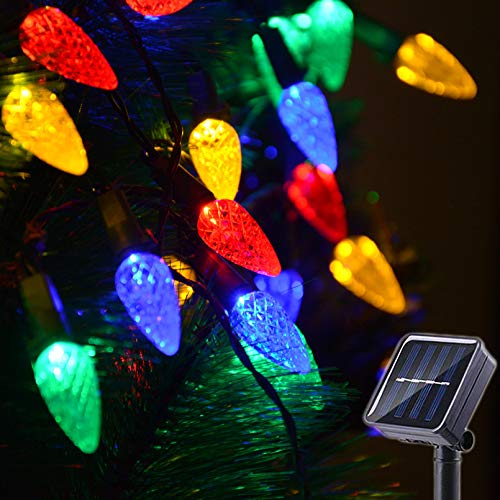
Solar Christmas lights pair an LED strand with a small solar panel and a built-in rechargeable battery. During the day the panel tops up the cell. At dusk a light sensor switches the strand on. It then runs until the stored charge fades. There is no cord to hide and no outlet to find. That makes these cordless lights ideal for a far fence, a garden bush, a mailbox, or any spot the extension cord will not reach. The catch is that runtime depends entirely on how much sun the solar panel caught, so placement of the panel matters as much as the lights. Our best solar Christmas lights roundup covers the strands that hold a charge best.
What battery Christmas lights are: AA and AAA cells, timer, on-demand
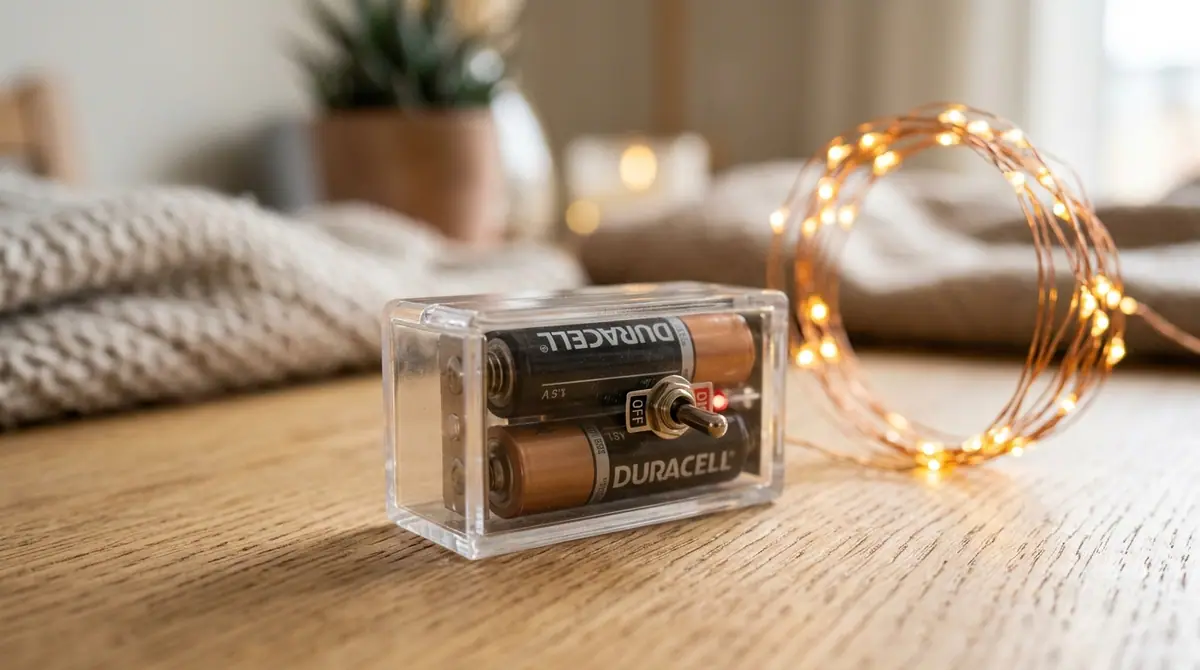
Battery Christmas lights run from a compact pack of AA cells, AAA cells, or built-in rechargeable cells. They light instantly, regardless of weather. Many include a timer that runs the set a few hours a night to stretch battery life across the season. That reliability and portability make them the go-to for indoor accents, a centerpiece, a wreath on a shaded door, a garland with no nearby plug, or anywhere you want the lights on exactly when you choose. These cordless string lights need no outlet either. The trade-off is ongoing battery cost and the chore of swapping cells. See the best battery-operated Christmas lights for sets with the longest runtime.
Solar vs battery Christmas lights: side by side
| Factor | Solar | Battery |
|---|---|---|
| Power source | Panel + rechargeable cell | AA/AAA or rechargeable cells |
| Needs sunlight? | Yes, to charge | No |
| Runs on demand? | Auto on at dusk only | Yes, whenever you switch on |
| Best placement | Sunny outdoor spots | Indoors, shade, anywhere |
| Ongoing cost | None after purchase | Replacement batteries |
| Winter runtime | Shorter (low sun) | Consistent (timer helps) |
| Setup | Cord-free, place panel in sun | Cord-free, load batteries |
Runtime and reliability: LED brightness and how long each lasts
This is the heart of the choice. Solar runtime swings with the weather. A bright day may give a full evening. A gray winter stretch may leave the strand running only a couple of hours. Battery runtime is predictable. You know a set of cells lasts a certain number of hours. A timer that runs six hours on and eighteen off can carry a set for weeks. If you need the lights on reliably every night, battery (or plug-in) is the safer bet. If you are happy with "on when charged," solar is the low-maintenance choice.
Placement, sunlight, and winter charge performance
Solar only makes sense where the panel gets real daytime sunlight. Think a south-facing fence, an open garden bed, or an unshaded path. Tuck the panel under an eave or behind a shrub and runtime collapses. In deep winter, short days and low sun cut the charge further. Clear snow off the solar panel and aim it at the brightest patch of sky. Battery lights do not care about sunlight at all. That is exactly why they win indoors, on shaded porches, and in the depths of a northern December.
Brightness, warm white LEDs, string lights and GFCI safety
Both run warm white or cool white LED bulbs to sip the limited stored energy. So both are best for accents rather than bold, whole-house displays. Neither matches a plug-in set for outlining a roofline or lighting a large outdoor tree. A stored charge can only push so many bright bulbs for so long. For those big jobs, corded string lights stay brighter and never run flat. See the best outdoor Christmas lights for plug-in options. Any plug-in outdoor run should go into a GFCI outlet. Whichever you choose outdoors, confirm it is rated for outdoor use, and keep battery packs and cells up off the wet ground.
Which should you buy: solar or battery?
Choose solar Christmas lights for permanent or hard-to-reach outdoor spots that get good daytime sun — far fences, garden beds, mailboxes, path edges — where you want a hands-off "charge by day, glow at night" set and no running cost.
Choose battery Christmas lights for indoor accents, shaded doors, centerpieces, wreaths, and any spot where you need reliable, on-demand light and precise timing more than cord-free convenience.
For big, bright displays, plug-in still wins. Weighing other options? Compare mini lights vs C9, browse the smart, solar and battery lights pillar, or the full Christmas lights comparisons hub.
Our Picks