
Affiliate Disclosure
Some links on this page are affiliate links. As an Amazon Associate, we earn from qualifying purchases — at no extra cost to you. We do not buy, install, or physically handle the lights and decorations we cover; our rankings come from aggregated owner feedback and expert consensus, not first-hand testing. Commissions never change our verdicts. How we research · full disclosure.
Top 3 Picks
To keep a Christmas tree from falling over, use a stand rated for your tree's height, center the trunk so the weight is balanced, level the base, and — if you have pets, small children, or a tree 7ft or taller — anchor it to the wall with clear fishing line. A stable, correctly sized base stops most tip-overs, and a simple wall tether handles the rest. Here's exactly how to set it up so a bump or a curious cat doesn't bring the whole thing down.
Why Christmas trees tip over in the first place
A tree falls for one of a few predictable reasons: the stand is too small for the tree, the trunk isn't centered so the load is off-balance, the floor is uneven or soft carpet lets the base rock, or the tree is top-heavy and lopsided. Add a pet brushing past or a toddler tugging a low branch and a marginal setup goes over. Fix the base and the balance and you remove the cause instead of chasing the symptom.
| Cause of tipping | What's happening | Fix |
|---|---|---|
| Undersized stand | Base is too narrow or not rated for the height | Use a stand rated to your tree height with a wide footprint |
| Off-center trunk | Weight leans to one side and pulls the tree over | Center the trunk; tighten bolts evenly in a cross pattern |
| Uneven floor | Base rocks on carpet or a sloped floor | Level the stand; add a flat board under it on carpet |
| Pets and children | Pulling branches or cords drags the tree down | Anchor to the wall; keep low ornaments and cords tucked |
Step 1: Choose a tree stand with the right height rating and footprint
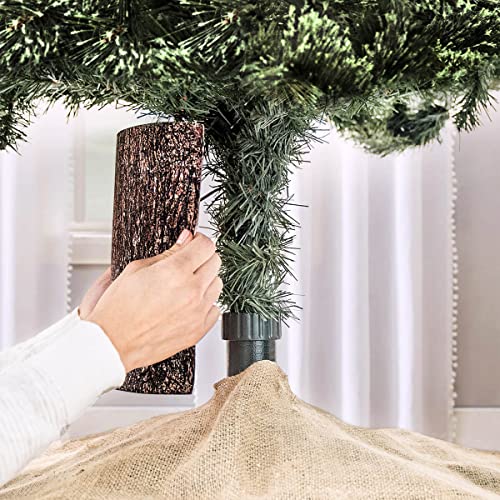
Stability starts with the base. For a real tree, a heavy cast-iron or wide plastic stand with a deep water reservoir and long bolts gives the biggest, steadiest footprint. Check the height rating on the box — the stand should meet or exceed your tree's height, because a 4ft-rated stand under a 7ft tree is a tip-over waiting to happen. For an artificial tree, use the widest matching base or a dedicated metal tree stand, and add a weighted plate or a Christmas tree collar to widen the footprint.
Step 2: Center the trunk and level the base
Set the trunk dead center in the stand and eyeball the tree from two directions to confirm it's plumb. Tighten the bolts against the bark in a cross pattern — opposite bolts a little at a time — so tension is even and the trunk can't shift. On carpet, slide a flat board or plywood square under the stand so the base can't rock in the pile. A few minutes of leveling here is what separates a solid tree from a nightly wobble.
Step 3: Anchor to the wall with fishing line for tall, top-heavy or pet-and-toddler trees
This is the single most effective safeguard, and it's nearly invisible. Tie clear fishing line or thin cord around the trunk in the top third of the tree, then run it to a small screw eye driven into a stud, a secure wall hook, or a window frame. One line is enough for most trees; use two lines at roughly opposite angles for a very tall or top-heavy tree. From a few feet away nobody sees it, but a shove, a leaping cat, or a grabbing toddler meets a firm stop instead of a falling tree.
Extra stability tricks: cast-iron stands, a tree collar and a full water reservoir
- Add weight low. Set sandbags, bricks, or a filled water jug inside or over the base legs to lower the center of gravity.
- Rotate the heavy side to the wall. Put the fullest, densest part of the tree toward the wall so the balance leans back, not into the room.
- Keep the reservoir full. A hydrated real trunk stays firmer in the stand and the tree stays fire-resistant.
- Manage the cords. Run light cords down the trunk and back to the outlet so nobody trips the tree by catching a loop.
- Re-check after a week. Trees settle and trunks dry, so re-tighten the bolts and top up the anchor line mid-season.
Choosing the base is half the battle — see our picks for the best Christmas tree stand and the best artificial Christmas tree. Decorating outdoors where wind is the enemy? Read how to secure outdoor Christmas decorations from wind. Childproofing the display too? See how to childproof Christmas tree lights. For more basics, visit the Christmas Lights 101 & Safety hub.
Our Picks