

Affiliate Disclosure
Some links on this page are affiliate links. As an Amazon Associate, we earn from qualifying purchases — at no extra cost to you. We do not buy, install, or physically handle the lights and decorations we cover; our rankings come from aggregated owner feedback and expert consensus, not first-hand testing. Commissions never change our verdicts. How we research · full disclosure.
Top 3 Picks
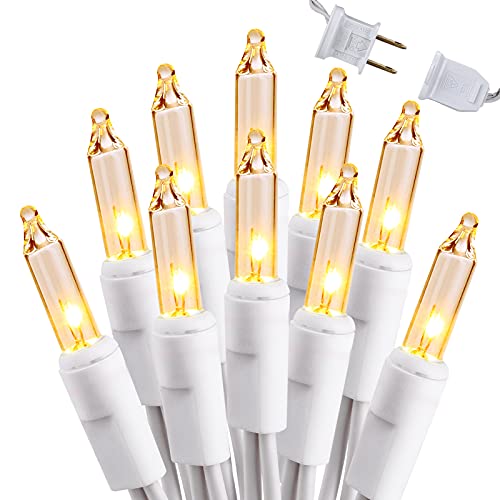
Incandescent Christmas lights last about 1,000 to 3,000 hours — roughly 3 to 6 holiday seasons for a display run a few hours a night. That's the rated life of the filament; individual bulbs burn out sooner, and one dead bulb can dim or kill a whole strand until it's replaced. For context, LED sets last 20,000 hours or more, which is why longevity is the main reason people switch. Here's what determines an incandescent set's lifespan and how to stretch it.
The lifespan of incandescent mini, C7 and C9 lights: rated life in operating hours
Bulb life is measured in operating hours, not calendar years, so how you use the lights decides how many seasons you get. Incandescent mini lights carry a rating in the 1,000-to-3,000-hour range. Do the math on a typical display — say 5 hours a night for a 42-day season, which is about 210 hours per year — and a 1,000-hour set lasts roughly 5 years while a 3,000-hour set could last a decade if the bulbs and wiring survive handling. In practice, physical wear from storage ends most strands before the filament rating does.
Why the tungsten filament burns out, especially in a series circuit
An incandescent bulb makes light by heating a thin tungsten filament until it glows. Every time it powers on and off, the filament expands and contracts, and over thousands of hours the metal slowly evaporates and thins until it breaks. That's normal wear. What makes it worse on old strands is series wiring: many mini-light sets run the bulbs in a series circuit, so when one bulb fails it can raise the voltage across the survivors and trigger a chain of burnouts. Heat, moisture, and rough handling all accelerate the process.
| Bulb type | Rated life | Approx. seasons | Filament? |
|---|---|---|---|
| Incandescent mini | 1,000 to 3,000 hours | ~3 to 6 | Yes — evaporates and breaks |
| C7 / C9 incandescent | 1,000 to 3,000 hours | ~3 to 6 | Yes — replaceable bulbs |
| LED | 20,000 to 50,000 hours | 10+ | No — solid-state, no filament |
Incandescent vs. LED lifespan: a 10x gap over the seasons
The table tells the story. LED Christmas lights last roughly ten to twenty times longer than incandescent because they have no filament to burn out — they're solid-state and simply dim very slowly over tens of thousands of hours. They also tolerate cold and rough handling far better. If you're tired of replacing strands or hunting for the one dead bulb that took out the row, longevity alone often justifies switching. See LED vs. incandescent Christmas lights and how long LED Christmas lights last for the full comparison.
How to make incandescent mini lights last longer: timer and gentle storage
- Use a timer. Fewer run hours means a longer life; a few evening hours beats all night. See the best Christmas light timer.
- Replace burnouts fast. A single dead bulb stresses the rest of a series strand — swap it before the cascade starts.
- Store them loosely. Coil strands without crushing bulbs; wrap around a reel or card rather than knotting.
- Keep them dry. Moisture corrodes sockets; store in a sealed bin and dry outdoor sets before packing.
- Don't overload. Staying within the connected-sets limit keeps voltage and heat in the safe zone.
Related reading: what are incandescent Christmas lights and how many watts LED Christmas lights use. When a strand does die, see how to fix Christmas lights and how to store Christmas lights. For more basics, visit the Christmas Lights 101 & Safety hub.
Our Picks